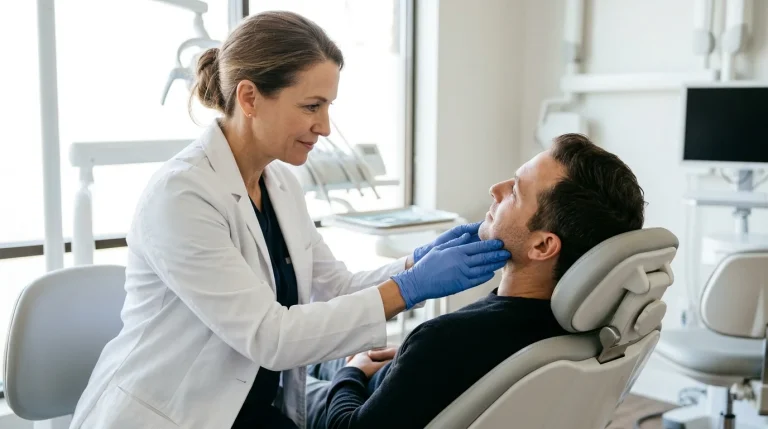
We explain what a maxillofacial surgeon does, which problems they solve and with which complaints patients are referred to them.
A maxillofacial surgeon treats diseases, injuries and deformities of the face, jaws and oral cavity. This doctor works at the intersection of surgery, dentistry and ENT.
Patients are often referred to them by a dentist, an ENT doctor or a trauma surgeon. Below we look at exactly what they treat and when you should see one.
In brief: what you need to know
- Who they areA surgeon who treats injuries, deformities and diseases of the face, jaws and oral cavity.
- What they doSurgery for fractures, malocclusion, cysts and growths in the maxillofacial region.
- When to see a doctorFor facial injuries, persistent deformities and growths found by a dentist or an ENT doctor.
Who is a maxillofacial surgeon
This is a specialist in surgery of the face and jaws who works where conventional dentistry or medical treatment is no longer enough.
Their area of work covers the bones of the facial skull, the upper and lower jaws, the temporomandibular joint, the soft tissues of the face, the salivary glands and the oral cavity.
They often work together with other doctors. For example, when correcting a bite, the maxillofacial surgeon works with an orthodontist, and in case of injuries, with a trauma surgeon and an ENT doctor.
What a maxillofacial surgeon treats
The surgeon's tasks fall into several large groups: injuries, deformities, growths and salivary gland diseases.
| Group | Examples | What the surgeon does |
|---|---|---|
| Injuries and fractures | Fractures of the jaws and cheekbone | Splinting, osteosynthesis, bone repositioning |
| Deformities and bite | Malocclusion, jaw deformities | Orthognathic surgery together with an orthodontist |
| Cysts and growths | Jaw cysts, benign growths | Removal of cysts and growths, biopsy |
| Salivary glands | Stones in the salivary gland ducts | Stone removal, gland surgery |
← Swipe to scroll the table →
At the SAIF PROFACE maxillofacial surgery center, operations are planned based on computed tomography data. Whenever possible, an intraoral approach is used, without incisions on the skin; if an external approach is necessary, cosmetic sutures are used.
More about maxillofacial surgery →When you should see a surgeon
Some reasons call for a scheduled appointment, while injuries to the face and jaw are urgent situations.
Patients are referred to a maxillofacial surgeon when there is:
- an injury to the face or jaw, a suspected fracture;
- a persistent malocclusion that cannot be corrected with braces alone;
- cysts, lumps or growths in the jaw and face area;
- swelling and pain in the salivary gland area;
- a referral from a dentist, orthodontist or ENT doctor.
The exact indications for surgery are determined by the doctor after an examination and tests. The doctor also decides whether surgery is needed at all or whether monitoring is enough.
Important
This article is for informational purposes only and does not replace a consultation with a doctor. The diagnosis, indications for surgery and treatment approach are determined by a specialist after an examination. Any surgery carries risks, which the surgeon discusses with you before the procedure. If a facial injury is accompanied by severe pain, bleeding or difficulty breathing, seek medical help immediately.
Frequently asked questions
How is a maxillofacial surgeon different from a dentist?
Do I need a referral to see one?
How are face and jaw operations planned?
What to do next
If you have complaints or a referral: book an appointment with a maxillofacial surgeon.
Want to learn about the center's capabilities: see the section on maxillofacial surgery.
Still have questions: call +998 (71) 200 22 20.
Book an appointment →